A tour
Somewhere between now and moving day there is an evening where you want to know what has to happen this week.
What you see when you log in
No course, no videos, no community. One workspace that says what you do and when, with the paperwork sitting next to it. Here is what is in it.
1. The personal timeline
You start with an intake of about ten minutes. Your moving date, who is coming with you, which kommune you are landing in if you already know that, and whether you are taking a job or starting out on your own. That is all we ask. Every answer can be changed later.
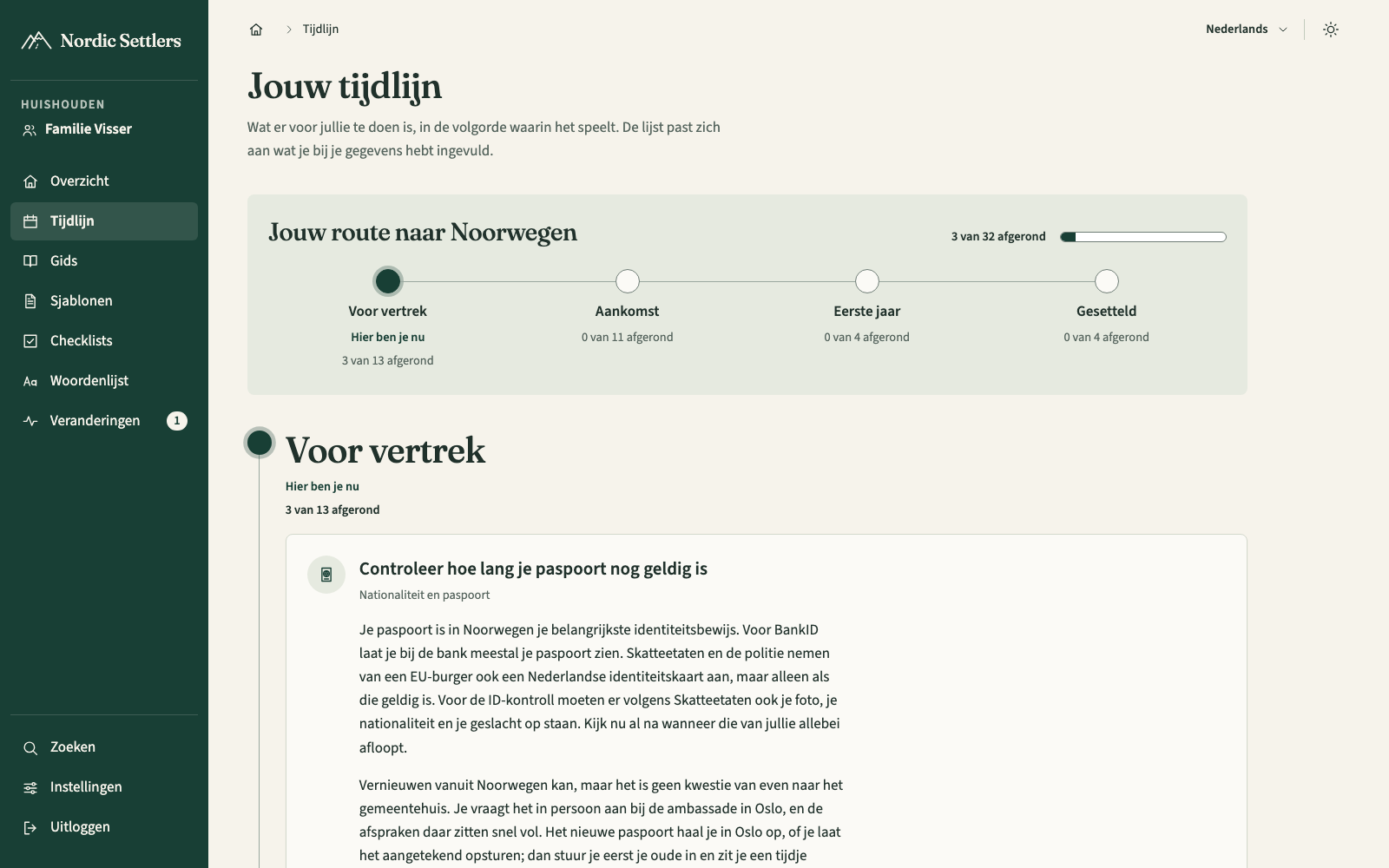
What you see after that is not a general checklist but a run of steps with dates on them. In a move, order matters more than completeness. Part of the list cannot happen until you are in Norway, because there is an ID check where you have to stand at the counter yourself. Another part has an eight-day clock that starts on the day you move in. And a few things on the Dutch side have to be finished before you go, because afterwards they get a great deal harder.
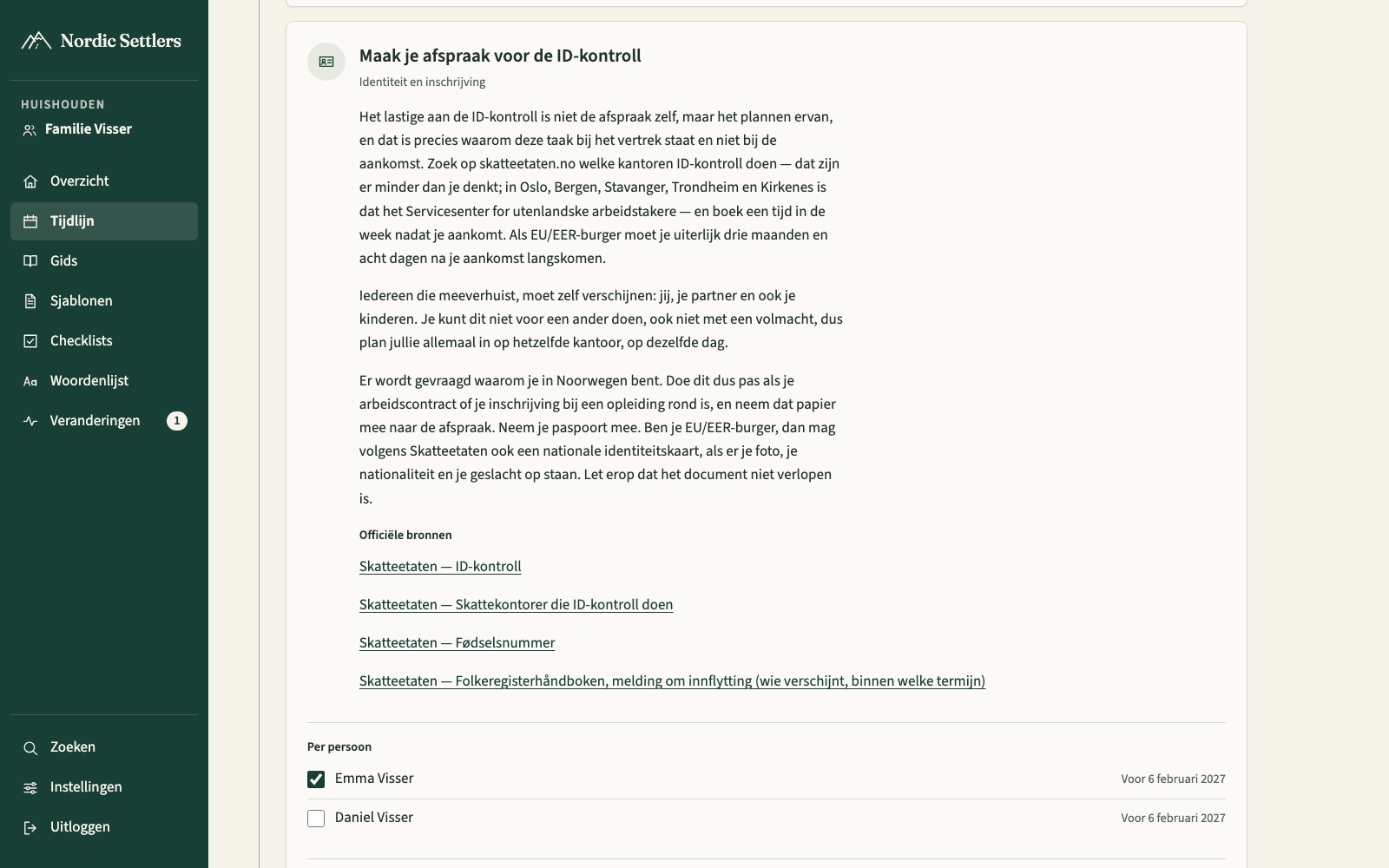
The steps sit in phases, in the order you meet them: Before departure, Arrival, First year and Settled. Where a step applies to everyone in the household, like checking how long each passport is still valid, you tick it off person by person.
Every step comes with articles from the guide, for the Norwegian and for the Dutch side. Each article is marked ‘Last checked on’ with a date, and lists the official sources it rests on.
If your move slips by six months, you change one date and the rest moves with it. That is the reason we do not sell a PDF.
2. Letters with your names filled in
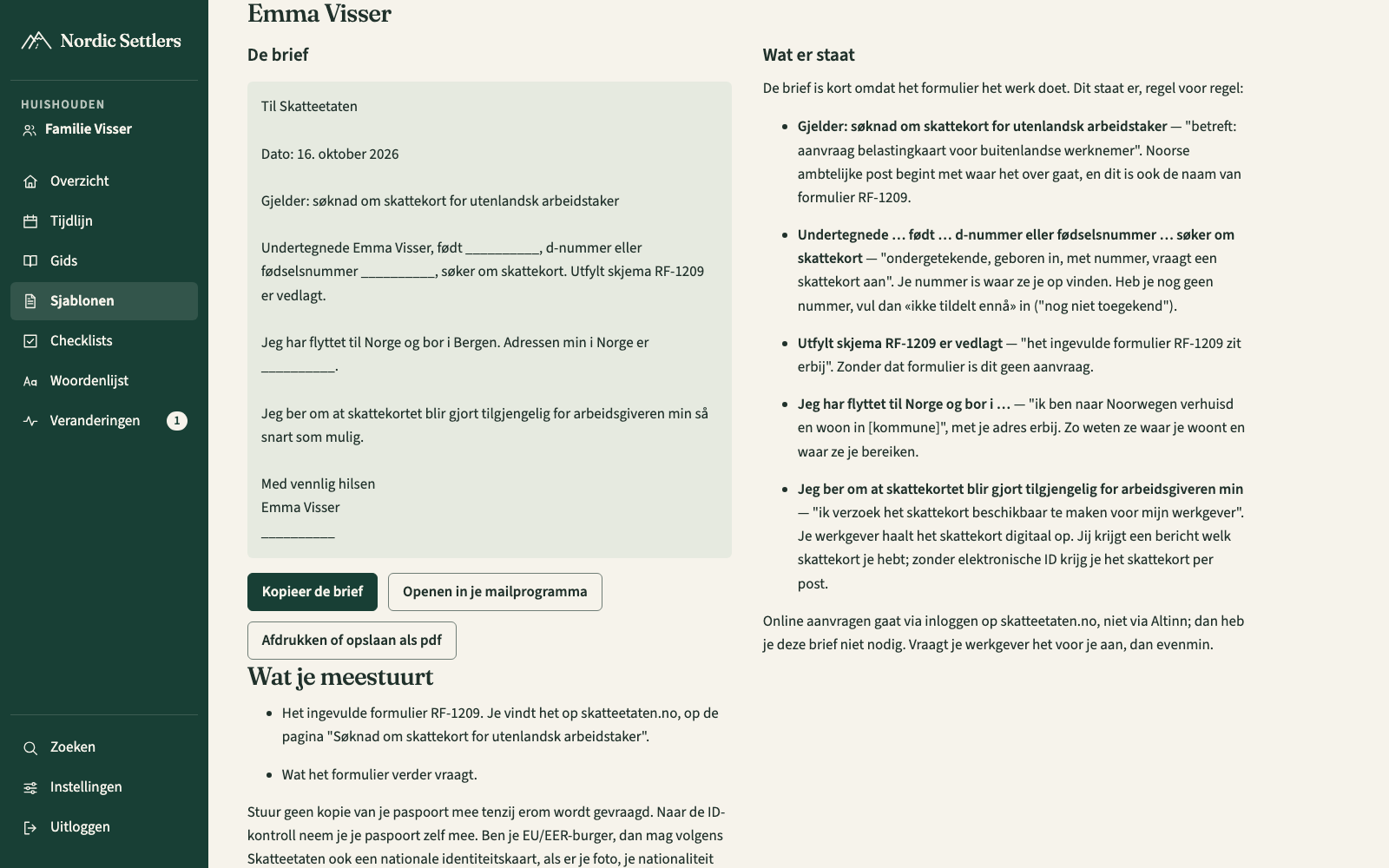
For the letters you have to send along the way there are templates ready, with the names from your household already in them. Beside each letter is an explanation of what it says, line by line, so you can read what you are sending before you press send.
One example: the letter to Skatteetaten that applies for a skattekort. The letter is in Norwegian, with your name already filled in. Beside it, in plain language, is what each line means, and underneath is what to send with it. You copy it, open it in your email program or print it.
3. A checklist per office
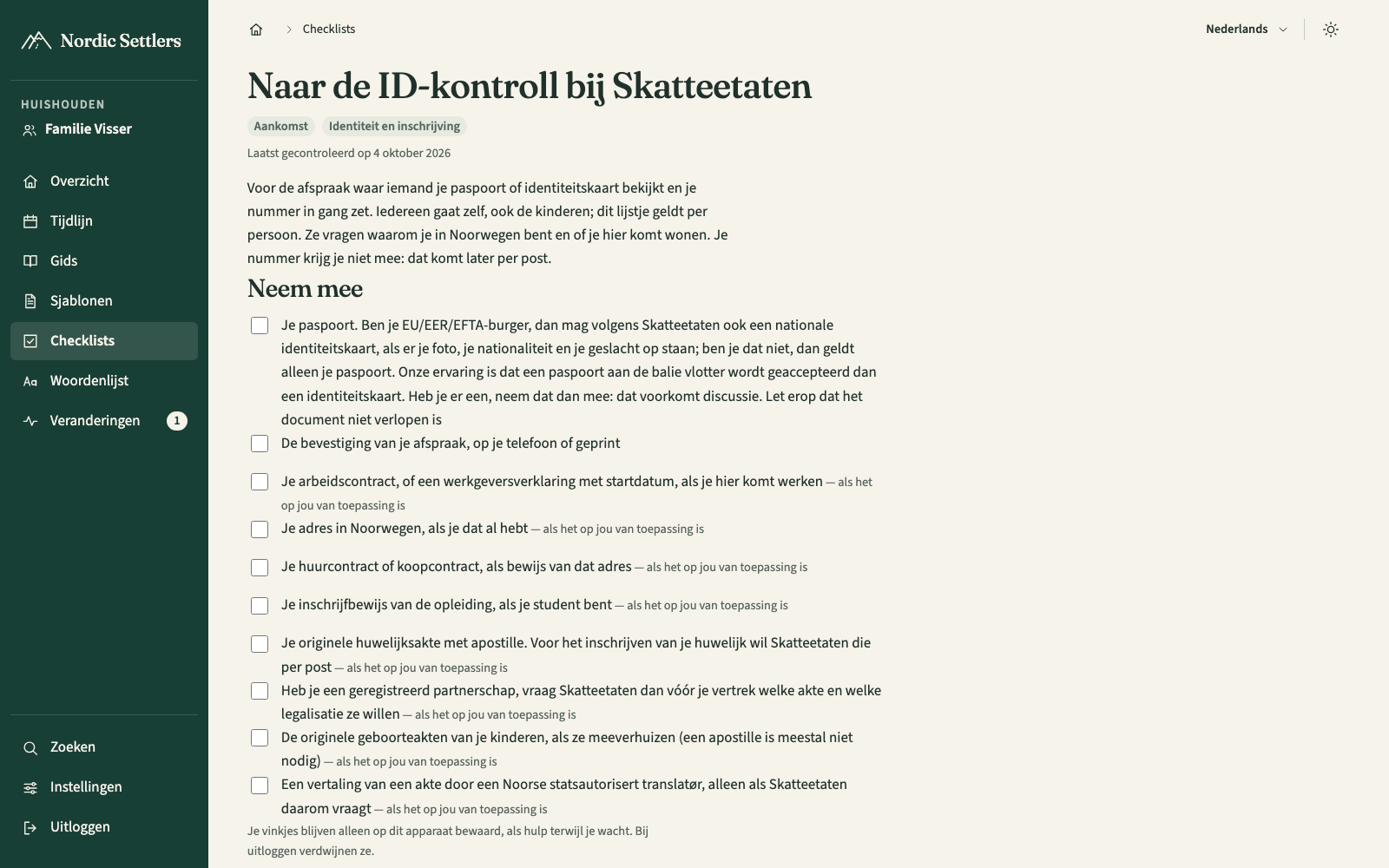
One sheet per counter. What to bring, what they ask, and what you walk out with. So you do not have to make the trip twice.
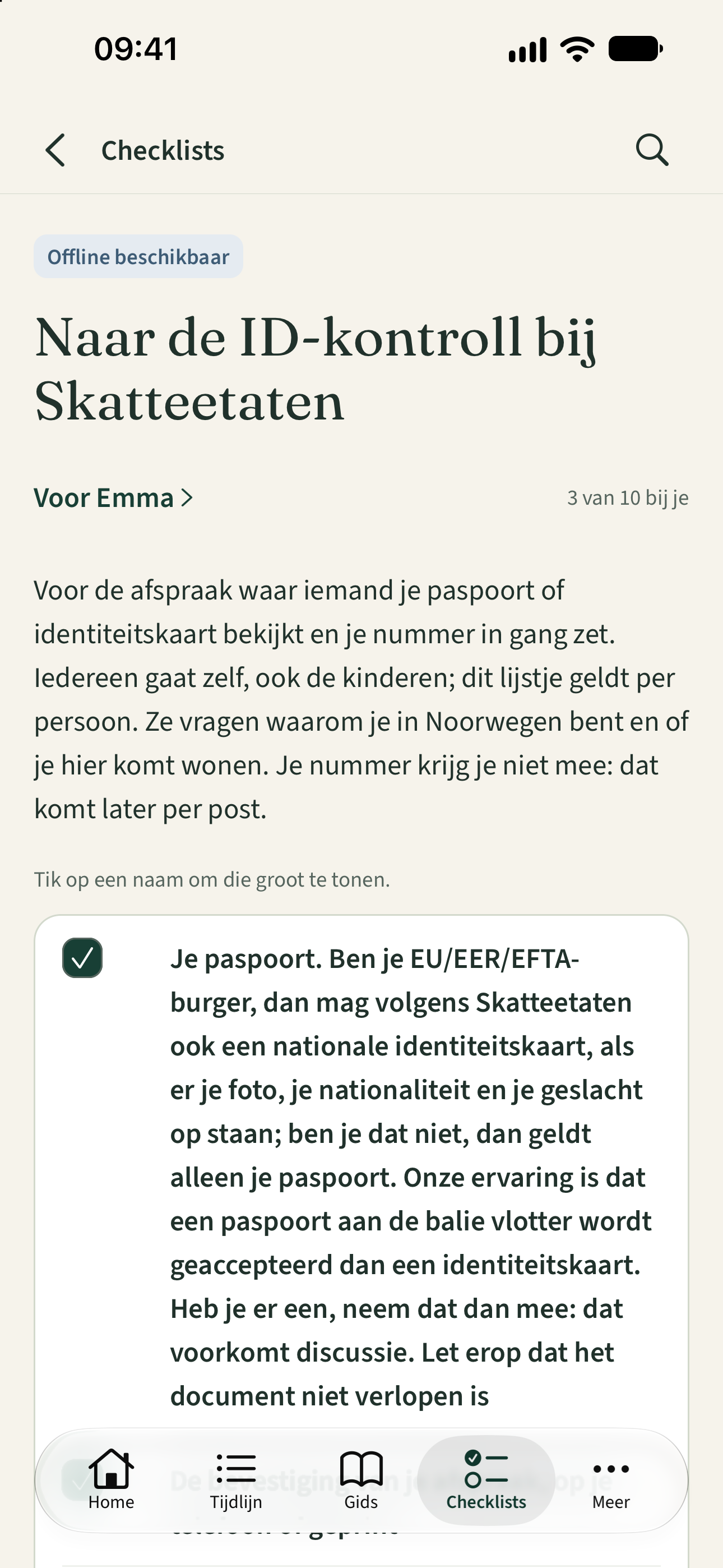
Most of the frustration does not come from anything being difficult. It comes from standing at the right counter with the wrong piece of paper. So there are sheets ready that you open on your phone while you are in the queue. They are short. You can tick them off. And each sheet carries the official source, so you can check for yourself whether we have it right.
Below are a few offices as examples, in Norway and in the Netherlands. There are 18 checklists in the platform.
What an agency asks of you can differ per office and per situation. The source is always the agency itself.
In Norway
Skatteetaten
The folkeregister (national population register), the ID check, and after that your skattekort (tax deduction card). Almost everything that comes later hangs off this.
- What to bring
- Passport, your rental or purchase contract, your employment contract, and birth certificates for the children.
- What they ask
- Where you live, how long you intend to stay, and where your income comes from.
- What you walk out with
- Confirmation that your move has been registered. Your fødselsnummer (national identity number) or D-nummer follows later, by post.
UDI
Registration for EU and EØS citizens staying longer than three months. Separate from the folkeregister, and with conditions of its own.
- What to bring
- Passport or ID card, plus proof of what you are here on: an employment contract, enrolment as a student, or your own means.
- What they ask
- On what grounds you are here and who is coming with you.
- What you walk out with
- A registreringsbevis, your registration certificate. You will be showing it at other counters for the rest of the year.
Politiet and ID-kontroll
The moments where you stand at the counter yourself and somebody picks up your passport. This is why part of your timeline cannot happen until you have landed.
- What to bring
- Passport, your appointment confirmation and every paper that belongs to the application. Your children’s as well.
- What they ask
- Whether you are who you say you are, and whether your papers belong together.
- What you walk out with
- A completed check, which is what lets the rest of your application move on.
Your kommune
Barnehage (day care and pre-school), school, water, waste and the local rates. Every kommune arranges this itself, so the dates differ from place to place.
- What to bring
- Your Norwegian address, your fødselsnummer once you have one, and your children’s details.
- What they ask
- When you want the children to start, and whether you are joining the hovedopptak.
- What you walk out with
- An application with a date on it, and the answer to which school belongs to your address.
Statens vegvesen
Your driving licence and your car. Two separate tracks, each with its own deadlines and its own costs.
- What to bring
- Dutch driving licence, passport, fødselsnummer, and for a car the registration papers.
- What they ask
- Since when you have lived in Norway and exactly what you want to bring in.
- What you walk out with
- An application under way, and a realistic estimate of what your car is going to cost you.
NAV
Barnetrygd (child benefit), your membership of the folketrygd (the national insurance scheme), and everything around illness, pregnancy and unemployment.
- What to bring
- Fødselsnummer, employment contract, your children’s details and the date you left the Netherlands.
- What they ask
- Since when you have lived here, and what is still running on the Dutch side.
- What you walk out with
- An application in progress, and clarity about the date from which you are covered for what.
Altinn
The digital letterbox of the Norwegian state. Post from Skatteetaten, NAV and Brønnøysund arrives here, not on your doormat.
- What to bring
- An electronic ID. Without one you can do next to nothing there, and for a lot of families that is the first thing that blocks them.
- What they ask
- Nothing. It is a letterbox, not a counter. But deadlines do start running the moment something drops into it.
- What you walk out with
- Your own post, and the ability to authorise your partner or your accountant.
In the Netherlands
Your gemeente
Declaring your departure from the Dutch population register. You need it if you will spend more than eight of the next twelve months outside the Netherlands.
- What to bring
- Valid proof of identity, your departure date and the address you are moving to.
- What they ask
- Exactly when you leave and who is going with you.
- What you walk out with
- Proof of deregistration. Keep it safe, other offices will ask to see it too.
Belastingdienst
Your tax return for the year you leave, your toeslagen (Dutch benefit payments) and your mortgage. Your deregistration date drives all three.
- What to bring
- DigiD, your deregistration date, your Norwegian address and your annual income statements.
- What they ask
- When you left and what you are keeping on in the Netherlands.
- What you walk out with
- Benefits stopped, and a tax return that matches the day you actually went.
DUO
Student debt and student finance. A debt simply travels with you, but the way your monthly payment is worked out changes.
- What to bring
- DigiD, your new address and your Norwegian income.
- What they ask
- Where you live and what you earn.
- What you walk out with
- A repayment that fits an income in kroner instead of euros.
SVB
Child benefit and the AOW, the Dutch state pension you build up year by year. Both hang on living or working in the Netherlands.
- What to bring
- Your departure date, your Norwegian address and your children’s details.
- What they ask
- Where you are going to live and where you are going to work.
- What you walk out with
- An end date for your child benefit, and in writing what happens to the pension you have built up.
Your health insurer
Your Dutch policy ends once you are no longer required to be insured there. That does not happen on its own, and the date is exact.
- What to bring
- Your proof of deregistration and the date your Norwegian cover starts.
- What they ask
- From when you no longer live or work in the Netherlands.
- What you walk out with
- An end date, and the answer to the only question that counts: is there a gap between the two.
4. The glossary
Norwegian bureaucracy has a vocabulary of its own, and the words you need are rarely in a dictionary. Folkeregister, fødselsnummer, D-nummer, skattekort, registreringsbevis, hovedopptak, borettslag, sameie, forkjøpsrett, tinglysing, feriepenger, a-melding. They are in a glossary of their own, a Norwegian–Dutch list, and they are explained on the spot where you meet them as well.
For each word you get what it literally means, what it means for you in practice, and where you are going to run into it. Often that gap is the whole point: feriepenger is not the holiday pay you are used to, and a borettslag is not a Dutch VvE with a Norwegian name on it.
5. Reminders
You get a nudge when something is up, and it hangs on your dates. Not on the day you happened to create an account. Move in May and it is about May. Push it back to November and the reminders move with you.
The reminders come by email: when someone’s passport in your household is about to expire, one for each person; when the skattemelding is due; when the barnehage application deadline is close; and while the window is open in which you can insure yourself voluntarily for the AOW, the Dutch state pension.
You switch them on and off yourself, per topic. There is no email sequence that starts running the moment you pay, and there is no offer hidden in them. The only reason we email you is that something in your timeline has a date attached to it.
6. The change log
Rules change, rates change, and forms move to a different page. A guide that keeps quiet about that is more dangerous after a year than no guide at all.
So every part carries a date: when we last held it against the official source. You see the same thing on the free articles in the knowledge base, so you can check whether we do what we say before you buy anything.
The log says what we changed, on what date, and which source prompted it. If a change touches a step that is still open in your timeline, you see it there too. And if you spot something yourself that no longer holds, we would like to hear about it. For us that is the cheapest form of quality control, and for you it is the fastest.
7. Logging in without a password
You type in your email address and get an email with a six-digit code or a link. Either one logs you in. There is no password, so there is nothing to forget, nothing to reuse and nothing to lose during a move in which you will lose enough as it is. If you like, you can add a passkey later and log in on your own phone or laptop without waiting for an email.
Two adults per household each get their own access at their own address. You do not have to share anything, and you both see the same timeline. In practice one of you takes the Norwegian side and the other takes the Dutch side, and that only works if you are not taking turns on one account. Your access does not expire.
Logging in happens on the platform itself, not on this site.
The app
8. Also on your phone
The app for iPhone and Android is included with every household’s access, at no extra cost.
- Log in with the same code as on the platform.
- The timeline and the checklists on your phone.
- Checklists offline too, for the queue at Skatteetaten without signal.
- Notifications on your phone for your reminders.
- Share a letter to Mail.
- A dark theme for the evening.
one-time, per household, lifetime access · inkl. mva (Norwegian VAT included). Want to see which topics are covered first? Read the full contents, phase by phase, including one complete sample topic.
Pay once, and the rest of your move comes with it
No subscription and no hourly rate. You buy access for your household, and it stays yours even when the move slips.